
Is Wilsonville Business-friendly?
Over the years, while serving on City committees, commissions, and now as a City Councilor, I've repeatedly heard claims that Wilsonville is not business friendly. Most of those comments have come through social media, community conversations, and now public testimony. After hearing this often enough, I decided it was time to find out what business owners themselves had to say, so as a City Councilor, I chose to find out for myself. My management philosophy has always been "trust but verify"—and ask plenty of questions along the way. I like to ask why, allot!
Rather than rely on secondhand opinions or the occasional spirited social media debate, I decided to go directly to the source.
My goal was to interview at least 20 Wilsonville-based businesses, focusing on newer establishments and those within the Town Center District. I also wanted a broad cross-section of our local economy, including retail, restaurants, fitness, manufacturing, beauty and professional services. The objective was straightforward:
What is it really like to open and/or operate a business in Wilsonville?
What is Wilsonville doing well?
Where are the frustrations?
And, most importantly, where are the opportunities for improvement?
So, I set out in early August to gather information.
The Questions
I deliberately kept the interviews open-ended. With so many high-profile issues being discussed in Wilsonville and throughout the region, I didn't want to steer anyone toward a particular subject or conclusion. I wanted each owner or manager to make it their interview, reflecting their own experiences, priorities, and concerns.
I asked seven basic questions:
How long have you been in business?
What type of business do you operate? This often naturally leads into a discussion about customers and the market the business serves.
What brought you to Wilsonville?
How was your experience working with City staff? This could include permitting, planning, inspections, licensing, development, or other interactions.
Is there anything City Staff could have done better during that process?
Approximately how many people do you employ? How many live in Wilsonville, and how many commute from outside the city?
What general issues are affecting your business today?
The final question was particularly important. I intentionally avoided mentioning taxes, regulations, traffic, housing, workforce availability, or utility costs. If those issues came up, I wanted them to come organically from the business owner, not me. After all, there's a big difference between asking someone what concerns them and handing them a list of things they should be concerned about.
The Results
When all was said and done, I interviewed 22 businesses, overachieving my original goal of 20 – where the conversations provided a broad range of experiences and some interesting insights.
What surprised me most was the generally positive reception to my questions, and about Wilsonville. Were there negative comments? Absolutely, and those are equally important. But overall, the responses were more positive than I expected based on the public commentary that originally prompted this exercise. Here’s a recap of the results:
1. How long have you been in business?
The businesses ranged from establishments preparing to open within days to those operating for more than 25 years. That diversity was particularly useful. A new business navigating startup, permitting, construction (if required), and inspections has a very different perspective from an established business that has operated in Wilsonville for decades. One is trying to get the doors open; the other is focused on keeping customers coming through them.
2. What types of businesses did I visit?
I visited a manufacturer, meat market and butcher shop, shipping store, fitness facilities, hotel, restaurant, appliance store, and other retail and service businesses. While 22 businesses cannot represent Wilsonville's entire commercial community, the variety provided a useful cross-section of industries, business models, and customer bases.
3. What brought them to Wilsonville?
The most common answer was location, location, location. Apparently, that familiar real estate expression applies just as much to running a business. Owners frequently cited Wilsonville's position along I-5, south of Portland and between the Portland and Salem markets. They viewed that location as an advantage for reaching customers, employees, suppliers, and the broader region.
Several also spoke positively of Wilsonville's future potential and its mix of commercial and industrial properties. The general view was that Wilsonville offers opportunities for non-retail businesses serving supply chains from both the Portland metropolitan area and the Willamette Valley.
4. How was their experience working with City staff?
This question went directly to the issue that started the entire exercise: Is Wilsonville business friendly?
Among newer businesses, the responses were generally positive. Owners described their interactions with City staff as smooth, helpful, and professional. Longer-established businesses typically reported fewer recent interactions unless they were expanding, remodeling, changing signage, or undertaking another project.
There were, however, some frustrations, particularly involving construction and sign permitting.
Through my commercial inspection work, I routinely see how complicated the path from planning to permitting, construction, inspection, and final occupancy can become. Multiple parties, regulations, revisions, and inspections create plenty of opportunities for delays and misunderstandings. Anyone who has managed a construction project knows that the straightest line between planning and completion occasionally resembles a plate of spaghetti. These challenges are certainly not unique to Wilsonville, but that doesn't mean we shouldn't look for opportunities to improve.
Signage was another interesting subject. There appears to be a gap between what City code permits and the creative ways some owners want to advertise their businesses. For a new business trying to attract customers, visibility matters. At the same time, the City has established standards governing signage. I don't yet have a conclusion on the sign issue, but it deserves a closer look. There may be opportunities to improve communication, clarify requirements, or better understand the challenges business owner’s encounter.
5. What could City staff do better?
This question produced another somewhat unexpected result. Most respondents said nothing in particular or couldn't immediately identify something City staff should be doing differently. My takeaway was that once owners work through their startup process, their attention quickly shifts to customers, employees, inventory, suppliers, operating costs, marketing, and growing the business.
In other words, once the doors are open, City Hall generally moves down the priority list. That's probably a good thing—most business owners would rather spend their time serving customers than navigating government processes.
Other Issues That Came Up
Although I kept the interviews open-ended, several subjects surfaced repeatedly. Four stood out.
1. Town Center
Ten businesses, primarily located in or near Town Center, expressed support for continued Town Center development. Their reasoning was fairly straightforward: additional activity could mean more customers. Owners saw increased vehicle and pedestrian traffic as opportunities to improve visibility, attract customers, and generate additional business. Several also viewed the residential component as an opportunity to expand their customer base. Additional housing could bring more people within walking or short driving distance of restaurants, shops, fitness facilities, and other services. From a business perspective, more people living, working, shopping, and spending time nearby creates a stronger and more consistent customer/economic base, supporting local businesses throughout the day and week.
These were their views, offered without my specifically asking them to take a position on Town Center development.
2. Traffic and I-5
Ten businesses, many in the Town Center area, identified traffic as a significant concern.
Peak-hour congestion and difficulty accessing I-5 were the most frequently mentioned problems. When an accident occurs on the freeway, traffic can spill onto local streets, affecting employees, customers, deliveries, and access to businesses.
Anyone who has tried to cross Wilsonville during a major I-5 incident knows that a five-minute trip can quickly turn into an opportunity to finish an entire podcast. The interviews reinforced an important connection between transportation and economic activity. Businesses depends on reliable access for customers, employees, and deliveries. A great location loses some of its advantage when people have difficulty getting there.
3. Argyle Square
Businesses I visited in Argyle Square were generally pleased with customer activity in the area. They identified the anchor businesses, existing traffic, and established customer base as important advantages.
I also encountered one of the widest ranges in business longevity there, from establishments preparing to open to others that have operated successfully for more than a decade. That combination of new investment and established businesses illustrates how commercial areas evolve. Successful anchor businesses can attract customers who, in turn, support smaller neighboring establishments.
4. Employees:
Do They Live in Wilsonville?
With an overall count of 192 employees, the overall results were somewhat better than I expected. Having four out of every ten employees living in the same community where they work suggests a meaningful connection between our local businesses and residents. But, in general conversation, it was assumed that a majority of the 51 employees not factored in the calculation did not live in the town, and if so, that could shift the numbers significantly – around +70% living outside of town. At the same time, the number commuting into Wilsonville reinforces the importance of transportation, housing availability, and regional access.
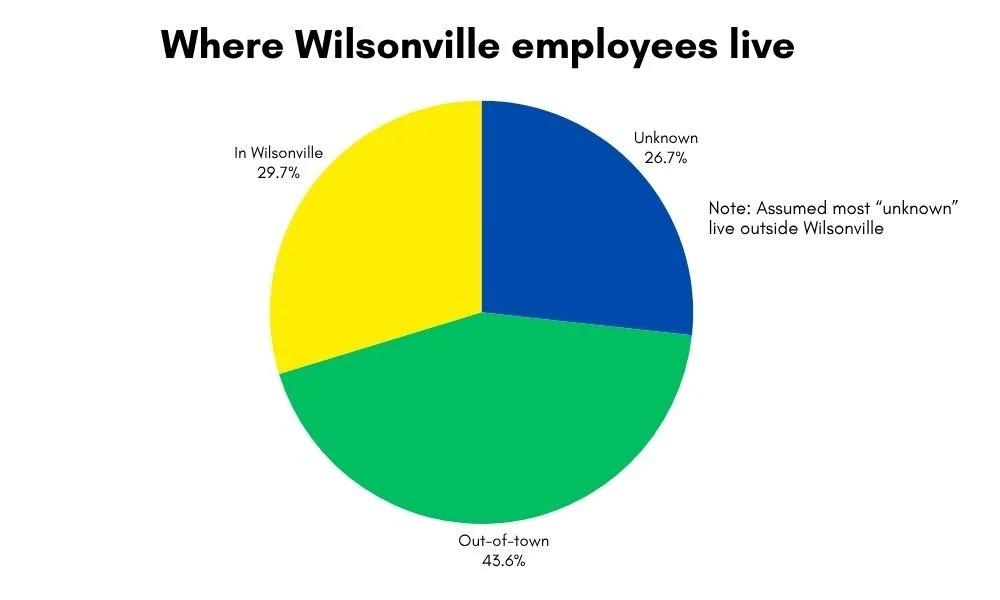
Businesses don't operate in isolation. They depend on both a local and regional workforces, just as they depend on local and regional customers. Maintaining a healthy business environment requires considering not only how we attract businesses but also how employees get to work and whether they have realistic opportunities to live closer to their jobs.
Final Thoughts
My observation is that Wilsonville appears to be doing reasonably well at attracting and retaining businesses. And other than a handful of large units/space (>15,000 sf), overall retail/commercial vacancy rate in town look to be average/low.
Can we do better? Certainly. Every organization has opportunities to improve. The key is identifying where those opportunities exist rather than assuming we already know the answer. These interviews painted a more nuanced picture than simply labeling Wilsonville business friendly or business unfriendly. I heard positive experiences with City staff and enthusiasm for Wilsonville's location and economic potential, along with concerns involving traffic, permitting, and signage.
During my manufacturing career, with large global employee populations, we frequently used the analogy of a three-legged stool to describe and measure our organizational success: People, Process, and Structure. If any one leg becomes weak, the entire organization becomes unstable. From these interviews, I see Wilsonville's business environment as a four-legged stool:
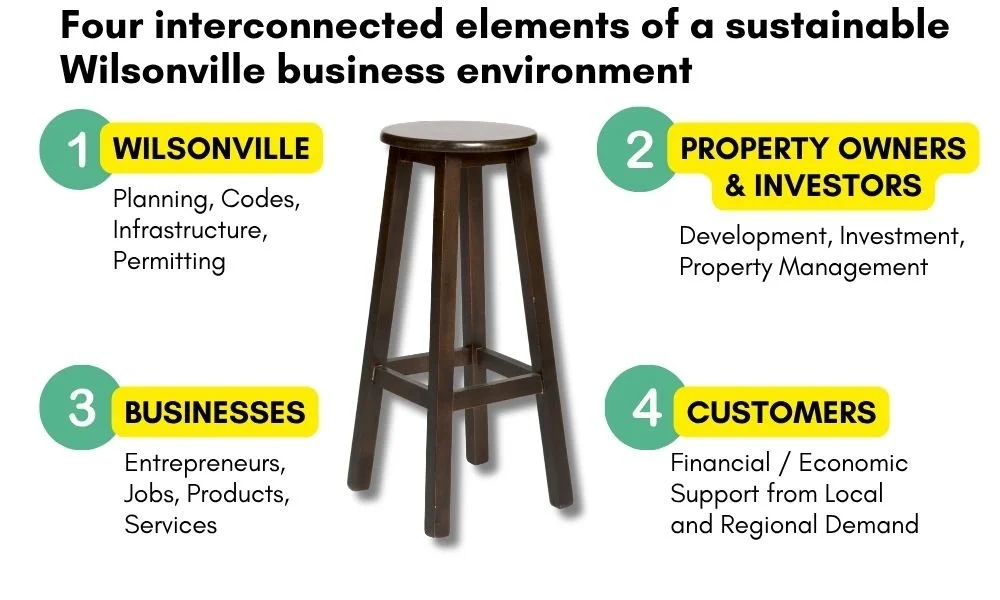
The City provides the planning framework, codes, infrastructure, and permitting processes. Property owners and investors develop and maintain commercial spaces. Entrepreneurs plan, take the financial risks, create jobs, and provide products and services. Finally, customers—both local and regional—generate the demand that keeps businesses viable.
That fourth leg, the customer, is critical and I don’t think we talk about it enough. We can have good planning, quality commercial space, and entrepreneurs/investors willing to invest, but none of that guarantees success without customers coming through the door. Economic development shouldn't end when the ribbon is cut. Opening the doors is only the beginning. Our longer-term goal should be a community environment where businesses can move from startup to stability and sustainable growth. And while the City has an important role, so do property owners, business operators, residents, and customers. Each leg supports the others.
Finally, these 22 interviews do not represent every business in Wilsonville, nor was this a scientific survey. What they provide is 22 firsthand conversations with people who have invested in our community, created jobs, and serve customers every day. Their experiences deserve to be part of the discussion. For me, this exercise was never intended to prove that Wilsonville is business friendly—or that it isn't. It was intended to ask the questions, go directly to the people who could help answer them, and listen.
Trust, but verify. Ask questions. Listen. Learn. And when we identify opportunities for continuous improvements, work to address them.
That's a process worth continuing. My next round of interviews will focus specifically on local restaurants and other food establishments—although I suspect that particular assignment may require a few more lunch breaks than usual
Are you a Wilsonville business owner who wants to share their experience with me? Please reach out and let’s connect.